
Java House Communication Skills
Welcome to Apply Communication Skills! This is not just a theory class—it's a hands-on workshop designed to transform how you connect, share ideas, and achieve your goals in both an academic and professional settings. In this course, you will move beyond the basics to actively practice and refine the core communication skills that Java House values most. Through interactive activities, real-world scenarios, and constructive feedback, you will develop the confidence and competence to communicate with clarity, listen actively, collaborate effectively and tailor your communication to different audiences, purposes and cultural contexts.
By the end of the course, you will have a portfolio of practical communication strategies and the demonstrated ability to apply them immediately. Get ready to participate, practice, and power up your professional presence!
This Course Includes:
Course Content
The Communication Skills Course, developed by Java House, is designed to strengthen employees' written, oral, nonverbal, and group communication skills. The course promotes clear communication, effective teamwork, professional customer interactions, and workplace collaboration, contributing to improved service delivery and organizational performance. It is intended for all Java House employees seeking to enhance their communication effectiveness in daily workplace operations.
Estimated time to complete: 40 hours.
-
Course Introductions and Announcements forum
-
Your preferred funding option assignment
-
End of Session 2 Assignment assignment
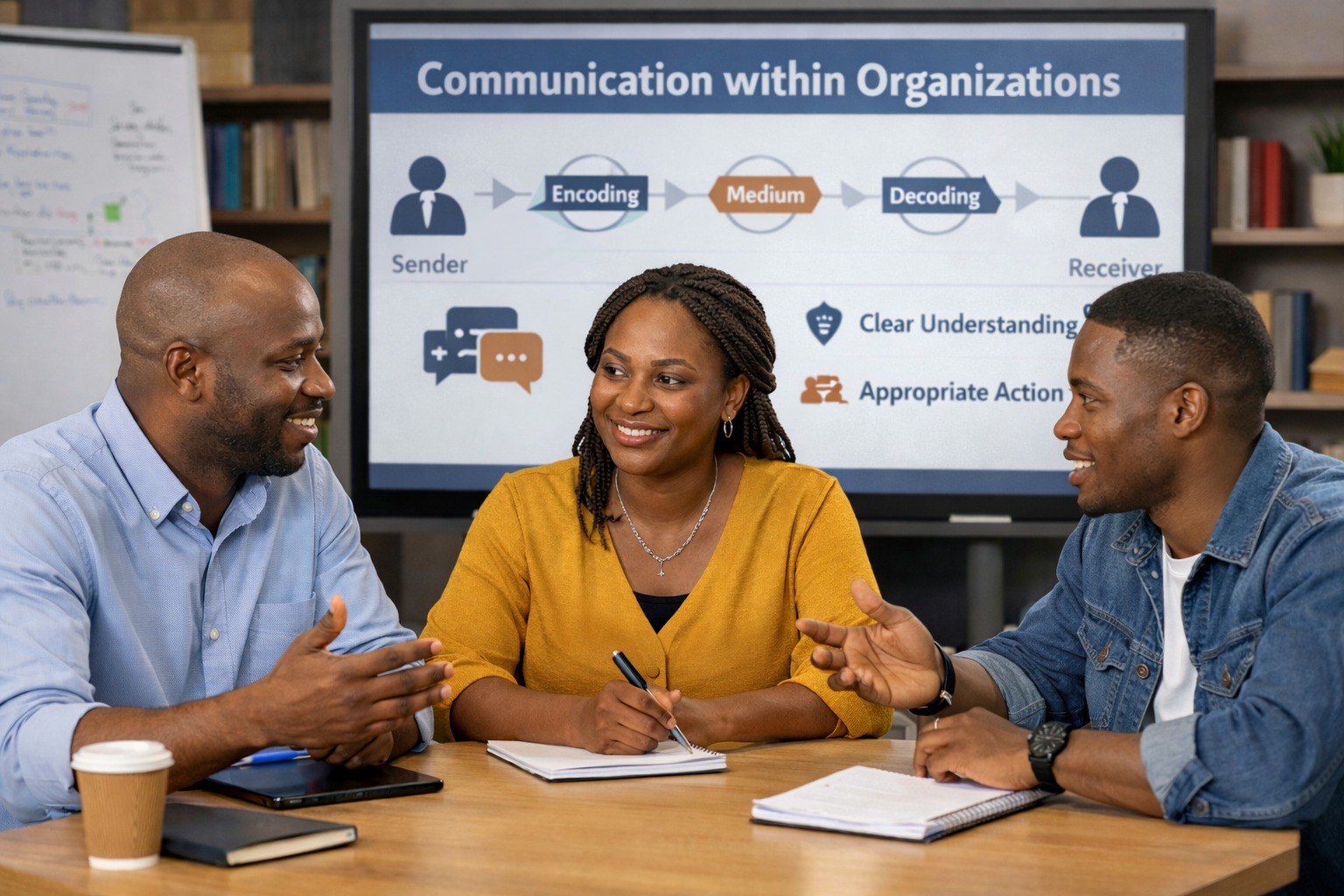
This session examines the core concepts and practices of organizational communication. Communication is a structured process of exchanging information, ideas, thoughts, or feelings among individuals, teams, or organizations, ensuring messages are accurately understood and appropriately acted upon. It covers key communication processes, principles of effective communication, channels and modes, factors influencing channel selection, barriers, communication flows, sources of information, and organizational policies guiding professional interactions. These concepts will enable you to communicate efficiently, professionally, and strategically in any organizational setting.
Click on the video below to start
-
Session 1 - Apply Communication Channels scorm
-
Course Evaluation Checklist (pdf) resource
Effective written communication is essential in academic and workplace settings, ensuring ideas, instructions, and information are conveyed clearly, accurately, and professionally. It enables learners and professionals to produce precise, understandable, and actionable documents such as letters, memos, reports, emails, and training plans. By understanding its types, key elements, organizational requirements, and common barriers, participants can improve professionalism, accountability, and alignment with institutional standards. This session explores the types and applications of written communication, essential elements of clear writing, organizational standards, barriers and strategies to overcome them, and systematic methods for analyzing, evaluating, and revising documents to ensure effectiveness and consistency.
-
Apply Written Communication Skills scorm
-
End of Session Assignment assignment
Applying non-verbal communication skills involves effectively using body language, facial expressions, gestures, posture, tone, and other cues to enhance professional and learning interactions. Non-verbal communication reinforces spoken messages, conveys emotions, regulates interactions, builds relationships, and projects professionalism. Mastery enables learners and professionals to interpret signals accurately, communicate across cultures, and maintain clarity despite language barriers.
This session examines the importance, techniques, and influencing factors of non-verbal communication in workplace and educational settings. Learners explore techniques such as facial expressions, gestures, posture, eye contact, appearance, proxemics (use of space), paralinguistics (voice and tone), haptics (touch), and chronemics (use of time). It also addresses how culture, gender, age, personality, and environmental factors shape non-verbal communication, helping participants adapt effectively in diverse contexts.
Click on the video below to start
-
Apply Non-Verbal Communication Skills scorm
We hope you have found this course valuable and are now equipped with the knowledge and skills to design and implement effective hybrid training plans. If you have completed all end-of-lesson assessments, you may download your Certificate of Completion below. Before you conclude, kindly take a few minutes to share your feedback by completing the End of Course
Survey (Estimated time: 30 minutes).
-
Certification page
This pre-course assessment session is an essential starting point in your learning path. It is designed to evaluate your existing knowledge, skills, and learning needs before beginning the course. It will help your facilitator tailor the course to your learning expectations while helping you reflect on your current competencies and learning outcomes.
Click on the link below to continue.
-
Scope page
Welcome to the course overview section. You will understand how the course is organized and determine whether you can undertake it. You must go through this section before proceeding.
Click on the video below to start.
-
Welcome To Communication Skills scorm
Instructor
Nicholas Kimolo
• 22 Students • 2 Courses
More Courses by Nicholas Kimolo

Free
OR